Let's start with the part nobody at Apple or Google will say out loud: neither company built a watch for games. These are health-and-notifications devices that happen to be able to run a game. Gaming is a side effect, not a strategy.
And yet, here you are. You want to tap out a quick round while you wait for coffee, and the watch on your wrist decides what you're allowed to play. So if you're choosing between an Apple Watch and a Wear OS watch, or just wondering what your current one can do, here's how they actually compare for gaming. We make watch games for a living, so this is the comparison we wish had existed when we started.
Apple Watch: more raw power, the single best control on any smartwatch, and a smoother but tightly curated selection. Best if you want polish and don't mind Apple deciding what runs.
Wear OS: more hardware choice and a far more open door (emulators, indie experiments, sideloading), but more fragmentation. Best if you want variety and don't mind a bit of tinkering.
Both bury their good games under phone apps wearing a watch icon. Finding the real ones is a job in itself, which is the entire reason this site exists.
Horsepower and controls
Apple has a genuine advantage here, and it comes down to consistency. Every Apple Watch runs the same class of Apple silicon and, crucially, the same Digital Crown: a precise, tactile scroll wheel that is the best game controller ever put on a wrist. Because there's exactly one of it, developers can build around it with confidence. Scroll to aim, press to fire, twist to steer. It just works, on every model.
Wear OS is not a watch, it's a fleet. The Pixel Watch 4 has a rotating crown. Samsung's Galaxy Watch line offers a rotating bezel on its Classic models, which is arguably even better for games than Apple's Crown. The new Xiaomi Watch 5 is touch-first. That variety is fantastic if you're a buyer and a headache if you're a developer, because a game tuned for Samsung's bezel feels different on a touch-only screen. The ceiling on Wear OS is high, but it's uneven.
Edge: Apple, for consistency. But a Galaxy Watch with a rotating bezel is the single best gaming hardware on either side.
The app stores (and why they let you down)
Here's the thing both platforms have in common: neither the watchOS App Store nor Google Play has a real "watch games" section. Search either for "watch games" and you'll get phone games wearing a watch icon, watch faces, and the same handful of apps that have sat at the top for years.
The genuinely good, made-for-the-wrist stuff is buried where nobody scrolls. On both platforms.
Where they split is openness. Wear OS, being Android underneath (Wear OS 6 is built on Android 16), lets you sideload and side-step. That's why full Game Boy and GBA emulators exist on Wear OS watches. Retro gaming on your wrist is a real, if nerdy, thing. Apple's review process is stricter, so emulation arrived late and cautiously, and anything that looks like running outside software gets scrutinized. If tinkering, emulators, and "wait, it can do that?" appeal to you, Wear OS is the friendlier home.
Edge: Wear OS if freedom matters to you. Edge: Apple if you'd rather everything be vetted and tidy.
Standalone, or tied to your phone?
Both platforms support standalone apps now, so the best watch games run without your phone nearby. The whole point of a wrist game is that it's there when your phone isn't. With cellular models on either side, you're genuinely untethered. This used to be a real differentiator, but today it's roughly a wash. Just check that a specific game is marked standalone before you count on playing it phone-free.
Edge: even.
Battery and session length
Games are one of the few things that will visibly drain a watch, because they light up the screen and lean on the processor. The good news is that watch games are built for minutes, not marathons, so a round of a reflex game or a daily puzzle costs you very little. Neither platform is meaningfully better here, and both are fine for the pick-up-and-play loop these games are designed around. If you're playing long enough for battery to matter, the game has probably overstayed its welcome on a watch anyway.
Edge: even.
Selection and quality
Apple's catalog skews more polished: fewer titles, but developers optimize hard for one hardware target, so what's there tends to feel finished. Wear OS skews more experimental: more indies, more oddball ideas, more emulators, so more misses but also more hidden gems you won't find anywhere else. Neither is "better." They're different kinds of fun: a curated boutique versus a sprawling flea market where the best finds are cheap and weird.
So which should you buy?
If you already own one, keep it. The gaming gap isn't wide enough to justify switching ecosystems. But if you're genuinely choosing:
Buy an Apple Watch if you want the most precise controls, the most polished titles, and you already live in Apple's world.
Buy a Wear OS watch if you want hardware choice (that Samsung bezel), emulators and the freedom to tinker, and you're on Android.
The honest truth, though, is that the best watch game is simply the one built for your wrist, and there are genuinely good ones on both platforms. The problem was never Apple versus Google. It's that neither of them helps you find the good stuff.
That's why we built SmartWatchFun. We play these games ourselves, on both platforms, and we only point you at the ones worth your time, ranked by how much people actually enjoyed them rather than how many downloaded them first. Whichever wrist you're on, start here.
Games shown in pictures
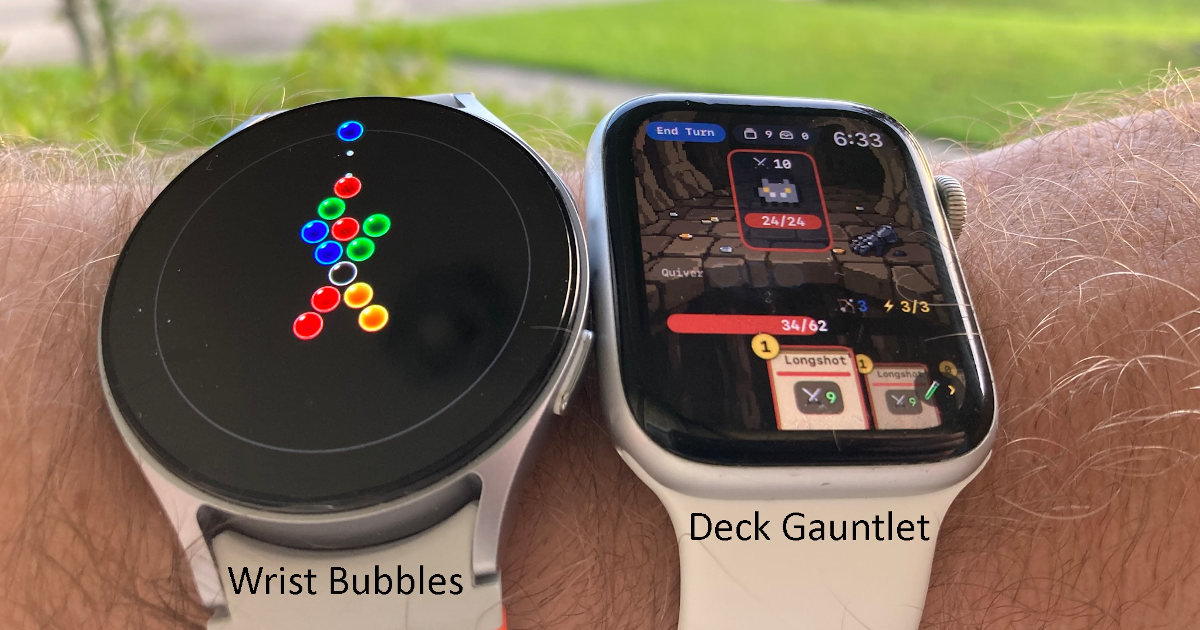
(Left) Wrist Bubbles - WearOS and Apple Watch
(Right) Deck Gauntlet (Coming soon) - WearOS and Apple Watch