Google's Pixel Watch 5 landed on August 20, 2026, starting at $399, and the spec sheet has one line that matters more to us than almost anyone else covering this launch: RAM finally moved from 2GB to 3GB. That's a 50% jump, and it's the first memory bump Google has made to the Pixel Watch line since it entered the smartwatch game back in 2022.
We build Wear OS games for a living at Stone Golem Studios, so we don't get excited about watches for the same reasons most tech sites do. We care about what a device can actually run, how long it can run it, and whether it chokes when three background processes and a game are all fighting for the same sliver of memory. Here's what the Pixel Watch 5 brings to the table, and why the RAM number is the headline for gamers even though the chip underneath it didn't change.
Chip: Snapdragon W5 Gen 2 "Accelerated," four Cortex-A53 cores at 1.7GHz, an Adreno 702 GPU at 1GHz, plus a Cortex-M55 co-processor for always-on tasks. Google is tuning the same silicon that's powered every Pixel Watch since 2023, not a new architecture.
RAM: 3GB, up from 2GB on the Pixel Watch 4. Google claims a 12% CPU boost and roughly 20% faster overall performance generation over generation.
Storage: 64GB, double the previous model's 32GB.
Display: 1.4" LTPO AMOLED "Actua 360" panel, 456x456 resolution, up to 3000 nits peak brightness, and an adaptive 1-60Hz refresh rate. Comes in 41mm and 45mm cases.
Battery: 332mAh (41mm) / 465mAh (45mm), rated up to 30-40 hours with always-on display active.
Software: Wear OS 7.0.
Why RAM is the story, not the GPU
The Adreno 702 GPU is identical to what shipped in last year's watch, so if you were hoping for a raw graphics horsepower jump, this isn't it. But for the kind of games that actually exist on Wear OS today, tap-timing games, puzzle games, endless runners, virtual pets, light RPGs, GPU horsepower was rarely the bottleneck. Available memory was.
A 50% increase in RAM means the watch can hold more of a game's assets in memory at once, switch between a game and a companion app (health tracking, notifications, a running Spotify session) without forcing a hard reload, and generally avoid the stutters and crashes that show up on memory-starved wearables the moment more than one thing is happening. If you've ever had a Wear OS game freeze or kick you back to the watch face after a phone notification came in, that's usually a memory management problem, not a graphics one. This is the fix Google chose to prioritize, and for our corner of the industry, it's the right call.
Doubled storage matters too. 64GB means you can actually keep a handful of games installed side by side instead of uninstalling one to make room for another, which has been a real limitation on 32GB Wear OS devices.
Games that will actually feel the extra RAM
Not every Wear OS game cares about this upgrade. A word puzzle or a tap-timer will run the same on 2GB or 3GB. The games that do care are the ones already pushing the ceiling on today's watches:
Combat Wear 2 by Stone Golem Studios is one of ours, flagged honestly. It's a full RPG on your wrist, and RPGs hold more in memory than almost any other watch genre: inventories, stats, dialogue, saved state. 4.4 stars.
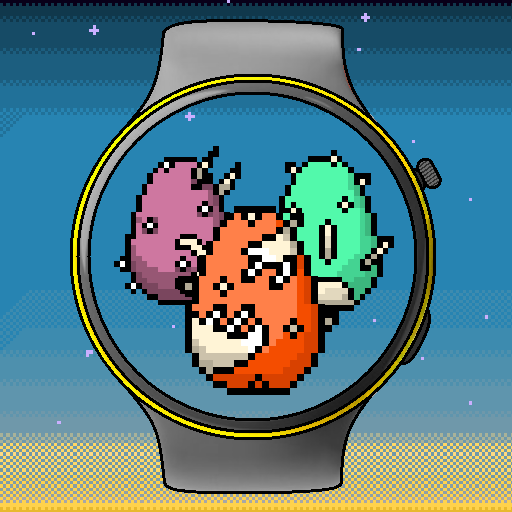
Wearamon, also ours, is a creature collector in the same boat. Collector and RPG games are exactly the titles that benefit most from 3GB, since they're juggling the most persistent data of anything on this list.
Then there are the emulators, the single most memory-hungry category on Wear OS. SquintBoy by Anaglych, WearGB, and WearGBA, both by , all keep an entire emulation core plus a loaded ROM in memory the whole time you're playing. That is precisely the workload a 2GB watch struggles with and a 3GB watch was built for.
The display and battery side of gaming
The Actua 360 panel's 1-60Hz adaptive refresh rate is built primarily for battery efficiency, but it pays off for gaming too. Fast-paced tap and swipe games get smoother motion when the panel ramps up, while the watch face and idle screens sip power at the low end. At up to 3000 nits, visibility in direct sunlight, a real problem for anyone gaming outdoors or mid-workout, shouldn't be an issue.
Battery life is the one place to keep expectations realistic. Google's 30-40 hour figures assume typical mixed use, not sustained gaming, which is a more demanding workload than checking notifications or tracking a run. Expect noticeably shorter runtime during active play sessions, as with any smartwatch.
Where this leaves the Pixel Watch 5 for gamers
Nobody should buy a Pixel Watch 5 expecting console-grade graphics on their wrist, that was never on the table, and the unchanged GPU confirms Google isn't chasing that either. What the RAM and storage upgrades actually deliver is a smoother, more stable experience for the games Wear OS is built for: less crashing, less waiting, more games installed at once, and better multitasking between a game and everything else running on your wrist.
For a platform where memory pressure has quietly been the biggest complaint from both players and developers, that's a meaningful upgrade even without a new chip.
We'll be back soon with a look at the Galaxy Watch 9's specs and what its 3nm Snapdragon Wear Elite chip, still paired with 2GB of RAM, means for gaming on Samsung's side of Wear OS.